BPMB VTEL Loan Saga Series: Facts vs Fiction
A summary of findings established by legal review and ICIJnews’ direct consultations with individuals close to the matter

Overview of VTEL and Corporate History
-
Established Pedigree: VTEL is not a "fly-by-night" operation; it is an established telecommunications firm that marks its 30th anniversary this year.
-
Market Innovation: In late 2010, VTEL—operating through Vasseti Datatech—became one of the first companies globally to offer 1Gbps broadband services. This launch was facilitated by a 2010 injection of telecommunications assets from Open Fibre Sdn Bhd.
-
Ownership Dispute: Between 2010 and 2014, Ranjeet and Tan Sri Syed Yusof allegedly seized control of VTEL from Open Fibre Sdn Bhd by intentionally withholding the consideration sum for a planned acquisition.
-
Control Structure: From December 2010 to July 2014—the period coinciding with the RM400 million Bank Pembangunan Malaysia Berhad (BPMB) loan—Ranjeet and Tan Sri Syed Yusof held over 78% beneficial ownership of VTEL. At that time, VTEL was 91% owned by Vasseti Berhad, which was a wholly-owned subsidiary of Vasseti UK Plc. The duo controlled over 87% of the shares in Vasseti UK Plc.
The BPMB RM400 Million Loan
-
Approval on Merit: The RM400 million loan was approved based on its own merits following rigorous research and due diligence by BPMB officers. Characterizing their professional efforts as "corrupt" or "senseless" is an unfair portrayal of their work.
-
Dato’ Zafer’s Non-Involvement: Dato’ Zafer did not approve the loan, nor did he participate in the decision-making process. He was not in Malaysia when the BPMB board—acting independently and without his influence—approved the facility in 2012.
-
Professional Boundaries: Dato’ Zafer maintained a strictly professional relationship with VTEL. While Ranjeet attempted to establish a personal connection, he was treated solely as a customer. In fact, Dato’ Zafer harbored a personal dislike for Ranjeet but maintained professional courtesy out of respect for Tan Sri Syed Yusof.
-
Governance and Compliance: Any waivers or variations to the loan conditions were executed by multi-member committees acting on the advice of internal and external legal counsel. No single individual, including Dato’ Zafer, possessed unilateral decision-making authority within BPMB.
Allegations of Mismanagement and Sabotage
-
Corporate Loss: Alleged theft and mismanagement by Ranjeet and Tan Sri Syed Yusof resulted in losses exceeding RM150 million for VTEL between 2010 and 2014. While the High Court of Malaya awarded RM150 million in damages to VTEL’s original shareholder, the award (to be paid via Vasseti UK Plc shares) was never realized. The company was delisted following the discovery of corporate misconduct, including the fraudulent sale of unpaid shares on the Frankfurt Stock Exchange.
-
Infrastructure and Revenue: The VTEL Coastal/Terrestrial Network Infrastructure was completed and commissioned in 2013, with all assets recorded in audited financial statements. Between 2013 and 2017, this infrastructure generated over RM799 million in revenue.
-
IPO Sabotage: VTEL was approved for a London IPO twice (AIM in 2015 and the LSE Main Market in 2017), seeking to raise £100 million to repay the BPMB loan in full. Both attempts were allegedly sabotaged by Ranjeet, Tan Sri Syed Yusof, and Nor Afidah Ghazali of BPMB. This is the subject of a counterclaim in Suit 313, scheduled for a hearing in July 2026.
-
The 2015 MACC Raid: During the 2015 IPO cooling-off period, Tan Sri Syed Yusof filed a false MACC report claiming his signature had been forged on share transfer forms. While the MACC raided VTEL, Ranjeet provided live updates to the investment bank, leading to the IPO's cancellation.
-
The 2017 Recovery Sabotage: Despite receiving a High Court Validation Order to proceed with a second IPO, and despite the support of BPMB’s CEO, Nor Afidah Ghazali (CFO/COO) allegedly sabotaged the effort by placing VTEL into the recovery department before the roadshow could begin.
Legal and Financial Standing
-
Winding-Up Circumstances: VTEL was not wound up by BPMB, but rather by LHDN in May 2022 over a debt of only RM75,000. This occurred while VTEL was under the control of Receivers and Managers (R&M) appointed by BPMB, who reportedly allowed the winding-up despite the company collecting millions in revenue.
-
Evidence of Infrastructure: A 2025 expert report commissioned by BPMB confirmed the existence of the Coastal/Terrestrial Network Infrastructure. Despite seven years of neglect and theft since 2018, traces of the infrastructure remain.
-
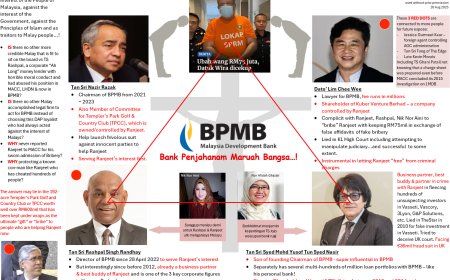
Conflict of Interest: Tan Sri Rashpal is noted as a long-term business partner of Ranjeet and is alleged to have fabricated his credentials to secure a board position at BPMB. Similarly, Dato’ Lim Chee Wee was a shareholder in Ranjeet’s Kuber Venture Berhad until 2024, receiving what is described as preferential share redemption.
-
Lack of Evidence Against Dato’ Zafer: There is no money trail linking Ranjeet to Dato’ Zafer. While Ranjeet allegedly paid "commissions" to Datuk Adah via Rothschilds Capital (I) Sdn Bhd—with a trail leading to Sidqi—it ends there. Dato’ Zafer never communicated with Ranjeet via personal text or calls, meeting him only five times in official capacities.
Current Legal Status (As of 2026)
-
NFA and Denials: Dato’ Zafer was never charged and received a "No Further Action" (NFA) notice in October 2022.
-
BPMB’s Inconsistency: Between 2021 and 2023, BPMB repeatedly denied allegations of bribery or corruption regarding the VTEL loan in various court filings (including the Court of Appeal and Federal Court), despite launching Suit 264. Furthermore, BPMB never reported a purported January 2022 "bribery admission" to the MACC.
-
Recent Pleas: In February 2026, Ranjeet pleaded not guilty to bribery charges.
-
Bank fails in bid to recover RM400mil loan from 30 parties: The High Court's dismissal of Bank Pembangunan Malaysia Bhd’s (BPMB) suit is a scathing indictment of the institution's legal strategy, with Justice Quay Chew Soon ruling that the bank fundamentally lacked the locus standi to pursue 30 defendants for funds it had already written off as "none of its concern" in previous proceedings. By "casually bypassing" the actual loan recipient to hunt for assets that were no longer its own, the bank was found to be in flagrant violation of the res judicata doctrine, effectively trying to litigate a matter the court deemed already settled or improperly brought. This humiliating defeat not only saw the bank’s claims shredded at the outset (in limine) without even reaching a trial on the merits, but also burdened the institution with RM325,000 in costs, exposing a desperate and legally unsustainable attempt to fix its own historical mismanagement through "fictitious" and "misconceived" litigation.